
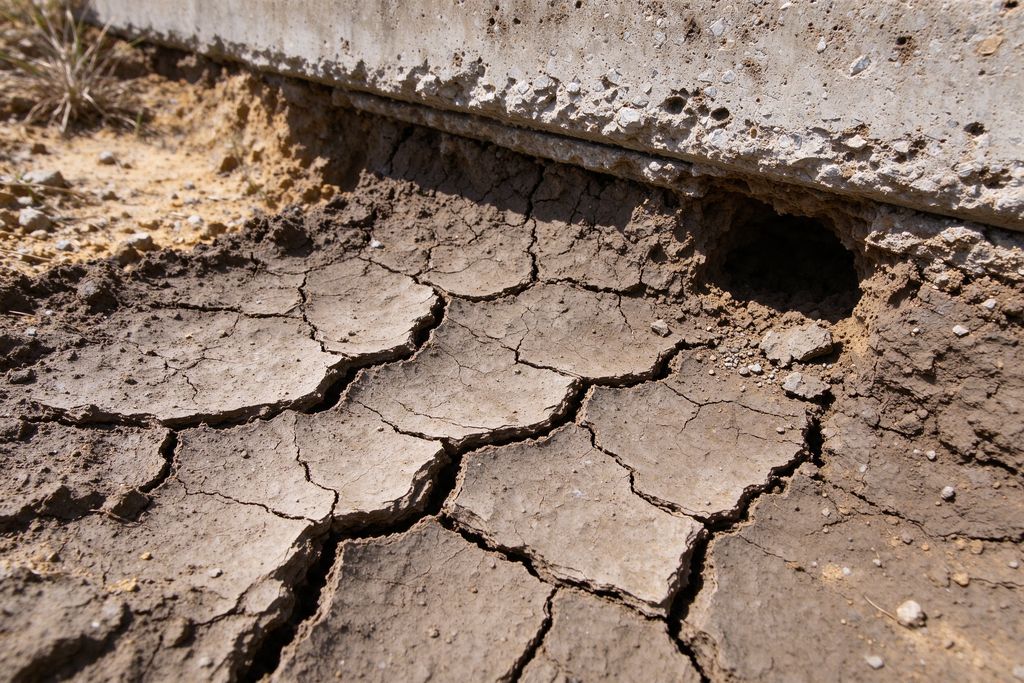
The slab is fine. The ground moved.
A typical residential driveway or patio is around four inches of concrete sitting on a thin layer of gravel or compacted soil. Concrete is strong in compression and weak in bending. As long as the ground supports it evenly, it does fine. When a pocket of support disappears, the slab bridges the gap for a while, then cracks or tips into it.
So the useful question is never "why did the concrete sink" but "what happened to the soil." Along the Front Range, from the Fort Collins area down through Denver, Colorado Springs and Pueblo, five answers cover most cases.
Tap the slab near the low edge with a hammer handle. A hollow, drum-like sound usually means a void underneath. A solid thud near the same spot suggests the slab settled together with its soil, which points to compaction rather than washout.
Swelling clay, the Front Range specialty
Much of the Front Range sits on clay-rich soils and weathered shale that contain bentonite, a clay mineral that soaks up water and swells. The Colorado Geological Survey has mapped swelling soils across large parts of the urban corridor. When that clay gets wet it expands; when it dries it shrinks and cracks into the polygon pattern you can see in a dry garden bed.
Slabs on swelling clay ride up and down with moisture. A lawn irrigated right to the edge of a walk, a dry strip under the eaves, and a wet spot by a downspout can all sit within a few feet of each other, so one slab can be pushed up at one end and dropped at the other.
Why this matters before you lift
Lifting only raises concrete. If a panel was pushed up by swelling clay, lifting its neighbours to match it sets you up for a surface that slopes the wrong way once the clay dries back. Look along the whole run of concrete with a long straightedge or string before deciding which panels are actually low.
Washout and roof water
Moving water carries fine soil with it. When a downspout empties at the edge of a patio or a sprinkler head sprays into a driveway joint, every storm and every watering cycle moves a little soil out from under the slab. Over a few seasons that becomes a void.
Roof water is the bigger of the two. A roof collects rain and snowmelt from its whole area and drops it onto a few small spots. A downspout that discharges right beside a slab is the single most common culprit behind a sunken patio corner or stoop.
- Soil stains fanning out from a joint after rain mean material is leaving.
- Gaps along a foundation where the slab has pulled away show water is running down that seam.
- Icy patches in winter at the same low corner tell you where melt collects and refreezes.
Loose backfill around newer homes
To pour a foundation, builders dig a hole larger than the house, then push soil back into the gap once the walls are up. That over-dig zone is often several feet wide and only lightly compacted. It keeps settling for years, especially when water soaks into it.
Anything built over that strip, such as a patio, front stoop, garage apron, or the first driveway panel, tends to tip toward the house. That is the worst possible direction: it steers water straight at the foundation.
The messy middle: the stoop that keeps leaving
A front stoop pulls away from the brick, someone caulks the gap, and two winters later the gap is back. The cause is the backfill under it, still settling, plus roof water entering the gap. Caulk alone cannot keep up. The durable fix is to lift the stoop if it is sound, fill the void, seal the joint with backer rod and flexible sealant, and move the downspout. If the stoop is hollow or tied into the foundation, get it inspected before anyone pumps material under it.
Freeze-thaw and poor original compaction
Colorado winters swing above and below freezing many times. Water that gets into an open joint freezes, expands, pries the joint a little wider, and lets more water in at the next thaw. Over time that pumps soil around and widens the path for washout. Deicing salts on top accelerate surface scaling and spalling.
Original construction matters too. A slab poured on loose, uncompacted soil, on organic material, or over a utility trench that was never properly tamped will settle no matter what the weather does. Trench lines are worth a look: a long, narrow dip across a driveway often follows a buried sewer or water line.
| What you see | Likely cause | First thing to fix |
|---|---|---|
| Low corner by a downspout | Washout from roof water | Extend the downspout away from the slab |
| Patio tilting toward the house | Settling backfill | Lift, then seal the house joint |
| Panels up one season, down the next | Swelling clay | Keep moisture steady; avoid irrigating at slab edges |
| Joints wider every spring | Freeze-thaw | Clean and seal the joints |
| Long narrow dip across a driveway | Poorly compacted trench | Locate the line before any drilling |
Symptom checker
Tick everything you notice on your own slab. The checker weighs the clues and names the most likely cause. It is a starting point for a conversation with a contractor, not a diagnosis.
Lift the slab and fix the water, in that order, in the same project. A lift on its own treats the symptom. Moving roof water, sealing joints and keeping irrigation off slab edges treats the cause. Read how to stop repeat sinking next.
Questions
Why does concrete sink near my house but not out by the street?
Slabs next to the house usually sit over backfill: the soil pushed back into the over-dig after the foundation was poured. It is looser than undisturbed ground and keeps settling for years, and it also catches the most roof water.
Is expansive soil the same as settling soil?
No. Expansive clay swells when wet and shrinks when dry, so it can push slabs up as well as let them down. Settling fill only compacts downward. Many Front Range lots have both.
Will lifting fix expansive soil?
No. Lifting fills a void and raises the slab. Keeping moisture under the slab steady, by sealing joints and moving water away, is what reduces clay movement.