
Why water is the whole game
Go back through the causes of sinking concrete: washout, swelling clay, frost in open joints, saturated backfill. Every one of them runs on water. Concrete slabs themselves are fairly water-tolerant; the soil under them is not. Keep the moisture under a slab steady and most of the movement stops.
That is why a lift without drainage work is half a job. The slab is up, the void is full, and the same downspout and the same open joint go right back to work on the same soil. The fixes below are cheap compared with lifting the same panel twice.
Sealing joints the right way
The joints that matter most are the ones that let water reach soil under a slab: the joint between the driveway and the garage apron, the seam where a patio or walk meets the foundation, and the control and expansion joints across driveways and walks.
Materials
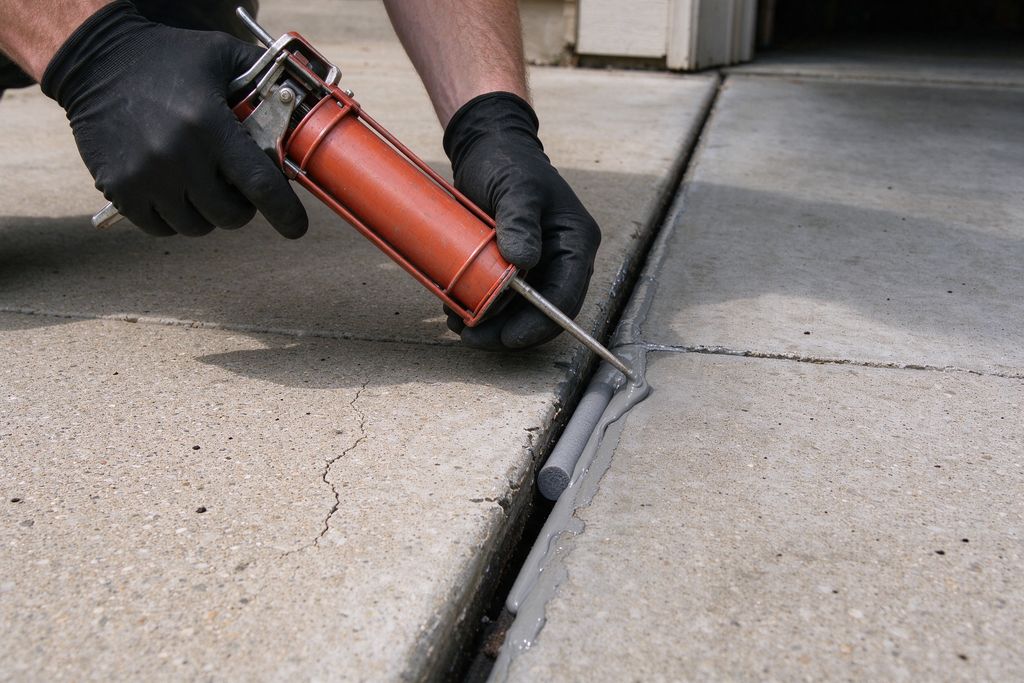
- Closed-cell foam backer rod, slightly larger than the joint width, pressed in to set the sealant depth and stop the sealant from bonding to the bottom of the joint.
- Flexible sealant made for horizontal concrete joints: self-leveling polyurethane or silicone products are common. It has to stretch as slabs move through Colorado's temperature swings.
- Not mortar or rigid filler. It cracks loose at the first freeze and gives water a channel.
Method
Clean the joint down past the old sealant, debris and weeds; a wire wheel or a joint plow helps. Let it dry fully. Push in backer rod to a consistent depth, then run the sealant so it sits slightly below the surface where tires and snow shovels will not catch it. Follow the product's temperature and cure instructions; cold or damp joints are the usual reason a bead fails early.
Seal after a lift, not before. Lifting moves panels and can tear fresh sealant. A crew that seals the joints as the last step of the lift job is doing it in the right order.
Roof water: move it, do not just slow it
A downspout concentrates the rain and snowmelt from a section of roof into one spot. If that spot is the edge of a patio, a stoop or a driveway joint, you have found the cause. The fix is to carry the water to ground that slopes away from both the slab and the house.
- Extensions are the cheapest fix; hinged ones flip up for mowing.
- Splash blocks help only if they point downhill and away from the slab.
- Buried drain lines carry water under a walk or lawn to an outlet that drains freely. Keep the outlet clear of the neighbour's property and the public sidewalk.
Check gutters too. Overflowing gutters dump water in a sheet right at the drip line, which is often directly over a patio or walk.
Grade and irrigation
Soil next to the house should fall away from it. Residential building codes commonly call for about 6 inches of fall within the first 10 feet from the foundation where the lot allows. Over the years, landscaping, settling backfill and mulch build-up flatten that slope or reverse it.
Irrigation is the quiet culprit on the Front Range. Spray heads that hit slab edges keep the clay underneath wet on one side and dry on the other, which is exactly the uneven moisture that makes swelling soils move. Adjust heads to spray away from concrete, and favour drip or low-water planting in beds that touch slabs and foundations.
The messy middle: the slab that moved after the lift
A patio is lifted in spring and looks right. By the next spring it has dropped again at one corner. The lift was fine; the downspout at that corner was never moved, and the joint to the house was never sealed. Each storm sent water down the seam, and the new fill underneath was eroded and saturated just like the old soil. The lesson: the drainage items belong in the same contract as the lift, with someone named as responsible for each one.
Common mistakes
| Mistake | Why it fails | Better |
|---|---|---|
| Mortar in joints | Rigid; cracks loose at the first freeze | Backer rod and flexible sealant |
| Sealant with no backer rod | Bonds on three sides, tears as slabs move | Rod first, bead on top |
| Downspout at the slab edge | Concentrated water undermines the slab | Extend or pipe it to a safe outlet |
| Sprinklers soaking slab edges | Uneven moisture moves clay | Adjust heads; drip in beds |
| Mulch piled against the house | Reverses the grade, holds water | Restore fall away from the foundation |
Sealing joints and moving roof water are the cheapest parts of any slab project and the parts that decide whether it lasts. Do them in the same job as the lift, and check them every spring.
Questions
What should I seal concrete joints with?
A flexible sealant rated for horizontal concrete joints, such as a self-leveling polyurethane or silicone product, installed over a closed-cell foam backer rod. Rigid fillers like mortar crack out as the slabs move.
How far should a downspout discharge from a slab?
Far enough that the water lands on ground sloping away from both the slab and the house, not at the slab edge. Extensions, splash blocks pointed the right way, or buried drain lines to daylight all work when the outlet ends in a safe spot.
How often do joints need resealing?
Inspect every spring. Sealant life varies with product, sun and traffic; reseal any joint where the bead has split, pulled away from the edge or gone hard.